THE DEMO
The Public Demo — April 2001
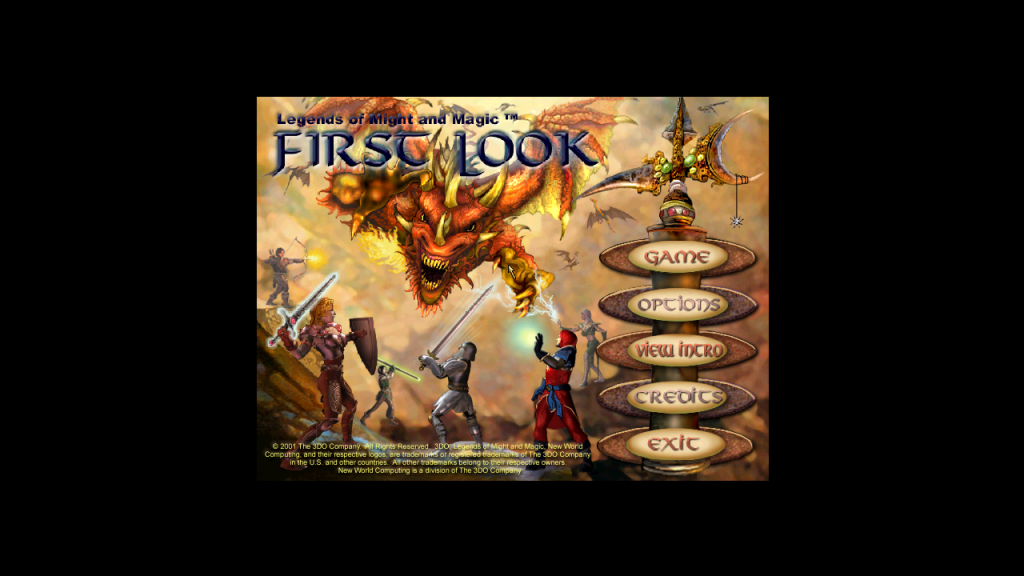
In the spring of 2001, New World Computing opened the gates early with a public multiplayer demo of Legends of Might and Magic. Released on April 18 2001, it was the community’s first glimpse of the game’s new team-based direction—months before the retail launch. Distributed through 3DO’s website and GameSpy mirrors, the “First Look” demo weighed in at roughly 82 MB and allowed up to 16 players to battle across two online maps using the new LithTech 2.0 engine.
The build included Internet and LAN support, class selection, gold earning, and the Good vs Evil team format. A built-in timer originally caused the demo to expire on June 15 2001, prompting 3DO to release a small patch that extended its life until the retail version arrived.
This demo marked the transition from Legends’ early cooperative concept to the fast, competitive combat that defined the final release—serving as both a public test and a historic preview of what was to come.
Echoes of the Demo Realms
Even after the full game’s release, the demo servers lived on for years — small, stubborn fragments of a bygone age still flickering with activity. As time passed and players gradually moved to the retail version, these servers grew quieter, eventually becoming something almost sacred: a digital monument to the beginnings of Legends of Might and Magic’s online life.
For many, the demo wasn’t just a preview — it was Legends. Not everyone could purchase the retail copy when it arrived; some were too young, others lacked the means or access to the game’s distribution. The demo remained a welcoming haven for those who couldn’t cross that retail threshold, and in its modest 82 MB world, friendships and rivalries alike were born.
Though it contained only two maps — Rescue at the Ruins and Temple of Bark — those arenas became home for countless players who fought, explored, and built the earliest Legends community. Entire demo clans formed within those walls, many of which later migrated to the retail servers, carrying their names, bonds, and stories into the wider realms.
What made the demo feel even more distinct was how intentionally constrained it was. Players were bound to just those two battlegrounds, with no access to super weapons and a tightly limited selection of usable gear. Many weapons, monsters, and items appeared in the gallery only as sealed crate image marked “Available in Retail Version”—a constant visual reminder that this was only a fragment of a much larger world waiting beyond reach. Scrolls, too, were entirely absent from play, unable to be purchased at all, further narrowing the tools available to players and shaping how battles unfolded.
The interface reinforced this separation between demo and retail in subtle but memorable ways. Certain options that would later become familiar simply did not exist yet. The server host menu contained no toggle for super weapons, and the player options lacked any setting for automatic weapon switching—both of which would appear only in the retail release. Even the sound options page felt different between versions; the demo presented a layout that many remember as offering a more hands-on feel, while the retail version streamlined those controls, giving each version its own distinct personality beyond content alone.
These limitations weren’t shortcomings—they were part of the demo’s identity. In a smaller, more focused space, players learned the rhythm of combat without excess, relying on mastery rather than spectacle. Every weapon mattered. Every corner of Rescue at the Ruins and Temple of Bark became familiar ground. And in that modest slice of Legends of Might and Magic, the experience never felt incomplete—only concentrated, intimate, and foundational.
Today, those demo worlds stand in memory as the first proving grounds of Legends of Might and Magic — humble yet enduring, the place where many of us first took up arms, learned the rhythm of battle, and felt what it meant to be part of something larger than ourselves. They remain, in spirit, the sacred foundations that led us to where we are now.
