PROMO VAULT
Welcome to the Promo Vault — a collection of official Legends of Might and Magic posters, ads, and promotional art from around the world. Here you’ll find the rare campaigns that defined the game’s identity, from its early RPG roots to its final multiplayer form.
North American Retail Reservation Ad (GameStop / FuncoLand) — 2000

This rare 2000 promotional ad for Legends of Might and Magic captures the game during its earliest incarnation — a story-driven Action-RPG that was later re-imagined before release. Issued by 3DO and New World Computing, the ad teases a grand adventure through four distinct worlds filled with dungeons, quests, and more than sixty unique creatures. At this point in development, Legends was powered by the LithTech 2.0 engine and envisioned as a cooperative experience of exploration and combat, where players would customize their heroes, battle through dynamic campaigns, and face a mad sorcerer determined to reshape history.
The tone of the ad — “Warrior Embattlements (Without the Messy Clean-Up)” — reflects 3DO’s early 2000s marketing flair, aimed at both RPG fans and a growing PC gaming audience. Screenshots reveal prototype armor, environments, and undead enemies that differ from what would appear in the final version a year later. By mid-2001, the project evolved into the competitive team-based multiplayer title built on LithTech 2.2 (Talon). This advertisement stands as a glimpse into the original ambition behind Legends of Might and Magic — a bridge between the classic Might and Magic adventure roots and the fast-paced, online fantasy combat that ultimately defined its release.
Tooth for a Tooth — The Forgotten Advertisement
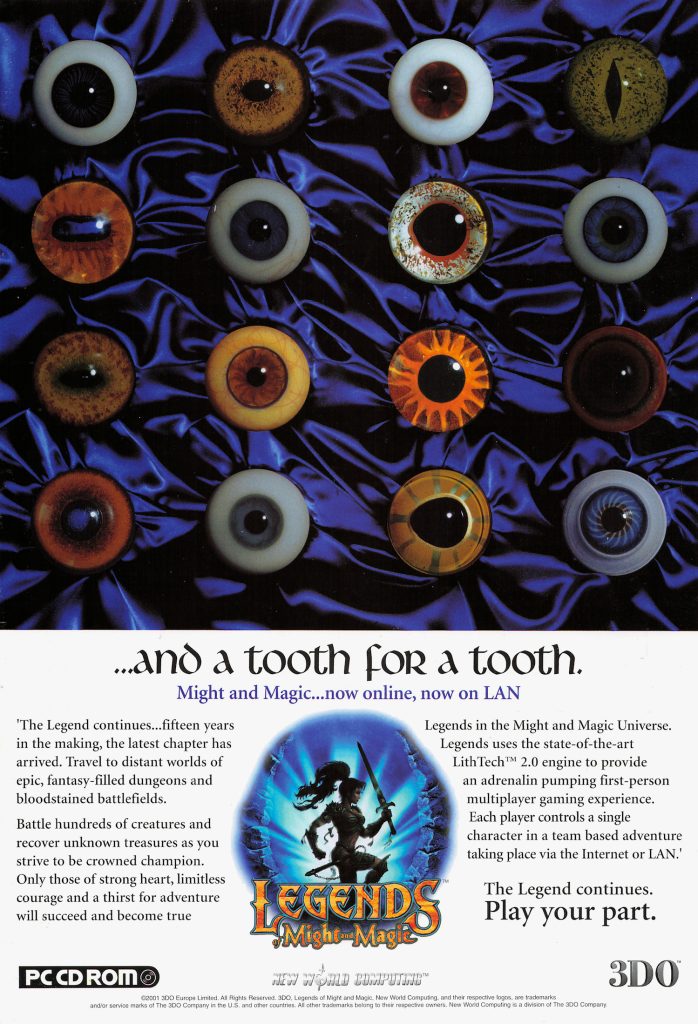
In mid-2000, Legends of Might and Magic stood at a crossroads — no longer the cooperative RPG it began as, yet not fully the team-based action game it would soon become. During this transitional period, 3DO released a striking promotional poster bearing the line “…and a tooth for a tooth.”
Rows of monstrous eyes stare outward from a silken blue backdrop, evoking vigilance, rivalry, and the sense that every champion is both hunter and hunted. The accompanying copy promises epic journeys, countless creatures, and treasure-filled worlds — an echo of the game’s original mythic ambitions blended with its emerging multiplayer identity.
This short-lived campaign captures a fleeting moment in Legends’ evolution, just before it shed its role-playing roots and stepped fully into its final, competitive form.
Early Pre-Release Announcement Card (Winter 2000)
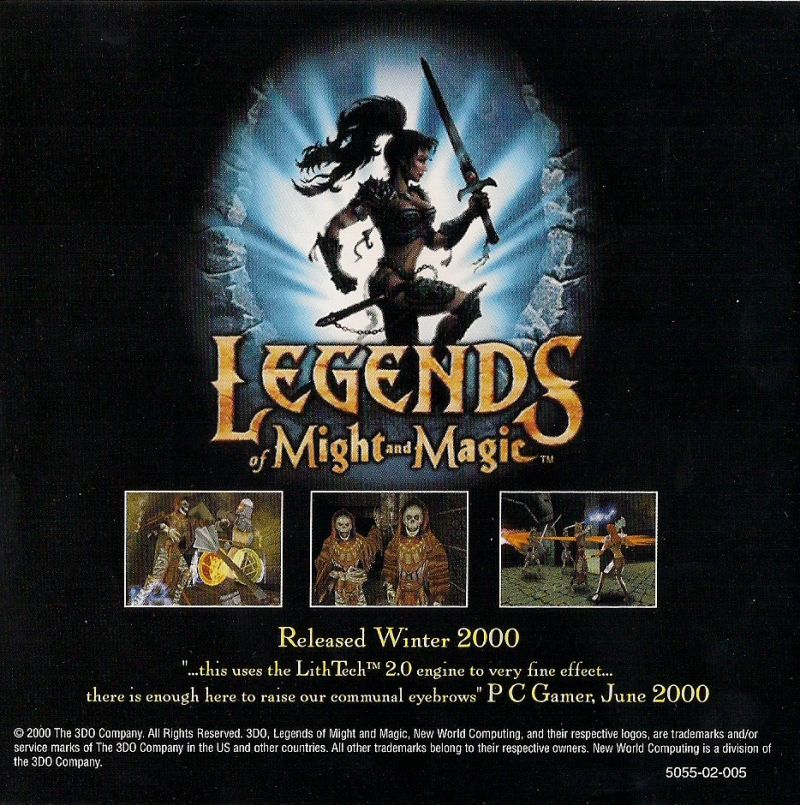
This pre-release Legends of Might and Magic poster, dated between June and December 2000, represents the game during its original Action-RPG phase—long before it evolved into the multiplayer arena title released the following year. Produced by 3DO and New World Computing, the poster advertised a “Winter 2000” launch and quoted PC Gamer’s early preview praising its use of the LithTech 2.0 engine. At that time, the game still featured traditional Might and Magic-style cooperative adventuring, a quest system, and early monster and armor designs that differed notably from the final version. By mid-2001, the technology had advanced to LithTech 2.2 (Talon), enabling the networked combat, team classes, and faster rendering seen in the released build. The poster captures that rare transitional moment—when Legends stood poised between its RPG roots and the competitive multiplayer form it would soon take.
North American ‘Are They Real?’ Magazine Ad (2000–2001)
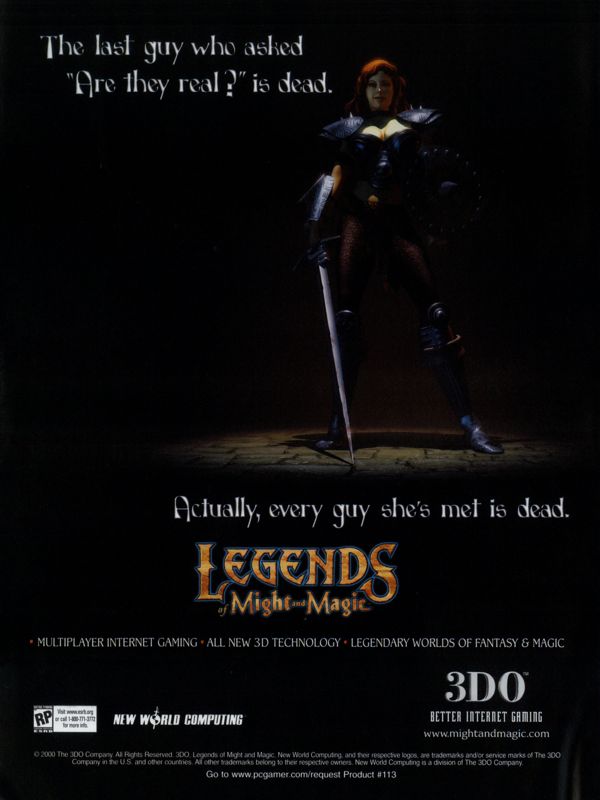
This 2000 Legends of Might and Magic advertisement is one of the most memorable and provocative pieces from 3DO’s early marketing campaign, released while the game was still deep in development at New World Computing. Featuring the red-haired Warrior standing confidently in shadow, the ad’s cheeky tagline — “The last guy who asked ‘Are they real?’ is dead. Actually, every guy she’s met is dead.” — leans into dark humor and attitude, positioning Legends as a bold, action-oriented evolution of the Might and Magic legacy.
At this point, Legends was still being promoted as a 3D multiplayer RPG running on the LithTech 2.0 engine, emphasizing cutting-edge visuals and online connectivity under the slogan “Better Internet Gaming.” The tone of the ad reflects 3DO’s push to capture a younger, edgier PC gaming audience, blending fantasy elements with the confident swagger of early 2000s game marketing. The Warrior character, who would go on to become one of the game’s most recognizable classes, is depicted here as both fierce and deadly — an embodiment of the world of Legends of Might and Magic, where strength, magic, and survival defined every encounter.
German ‘Legends Never Die’ Promotional Poster (2001)
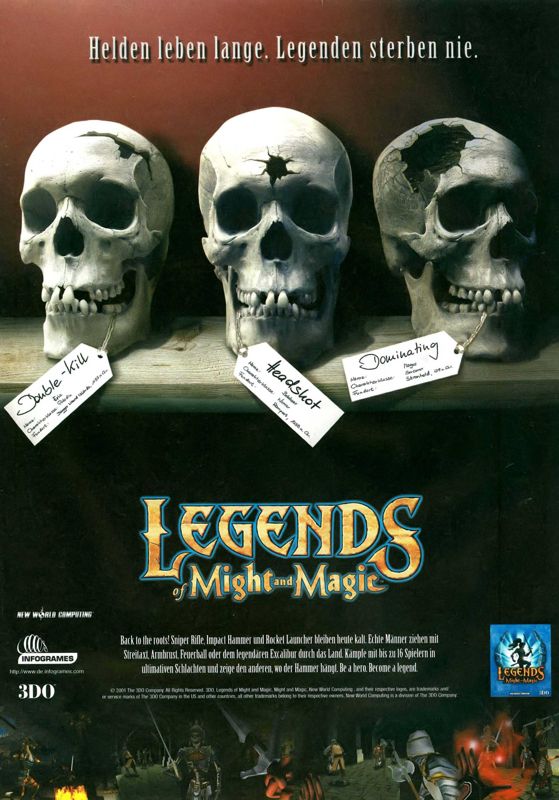
Translated as “Heroes live long. Legends never die.”, this powerful German advertisement for Legends of Might and Magic stands out as one of the boldest pieces from the game’s European marketing campaign. Released in 2001 under Infogrames and 3DO, the poster uses a darkly humorous motif: three skulls, each tagged with multiplayer kill callouts — “Double-Kill,” “Headshot,” and “Dominating.” This design captured the game’s shift into competitive online combat, evoking both medieval brutality and the adrenaline of early 2000s LAN deathmatch culture.
The copy at the bottom celebrates the game’s weapon variety and class warfare, invoking “sword, crossbow, and fireball” alongside modern phrasing like “Sniper Rifle” and “Rocket Launcher,” showing how Legends positioned itself as a fantasy shooter hybrid rather than a traditional RPG. The inclusion of Excalibur references and gothic imagery rooted it firmly in the Might and Magic universe while appealing to a European audience familiar with titles like Unreal Tournament and Quake III Arena.
With its blend of macabre wit and gritty visual realism, this poster perfectly encapsulates Legends of Might and Magic’s final identity — a world where chivalry met carnage, and the line between hero and legend was measured by the skulls left behind.
Scandinavian Legends of Might and Magic Retail Poster (2001)

This Swedish Legends of Might and Magic poster, distributed by PAN Interactive in 2001, presents one of the most striking regional adaptations of the game’s global marketing campaign. Featuring the iconic female Warrior breaking through stone and emerging into radiant light, it symbolizes both defiance and heroism—themes central to the Might and Magic universe. The Swedish tagline translates to “Good versus evil. Team against team. Fight in a legendary spirit… Log in, form teams—and experience the legend, online!” emphasizing the game’s transition from single-player fantasy adventures to a new age of team-based online combat.
Released under 3DO and New World Computing, this edition maintained full English gameplay but localized its promotional materials for Nordic audiences, where LAN and online gaming were rapidly growing communities. The poster captures the bold energy of early 2000s multiplayer fantasy—melding the medieval art style of the Might and Magic legacy with modern competitive online play, powered by the LithTech engine. It’s a perfect snapshot of how Legends was positioned as both an evolution of classic RPG worlds and a leap into the next era of online gaming.
Early Legends of Might and Magic Pre-Release Ad (2000)
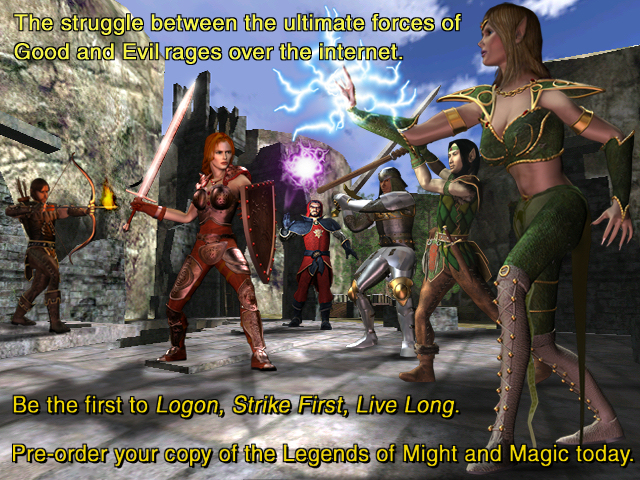
This striking early Legends of Might and Magic promotion wasn’t captured from gameplay — it was a studio composite. Each hero was rendered separately in the LithTech model viewer, then digitally arranged onto a static courtyard backdrop to create the illusion of battle. The result gives the characters their slightly oversized, “cut-out” look compared to their surroundings.
Like many early-2000s ads, the goal wasn’t realism but impact. The artists wanted to show every major class — Warrior, Paladin, Archer, Sorceress, and more — locked in combat, embodying the promise of online warfare between Good and Evil. It’s a dramatic, stylized glimpse at how Legends first introduced itself to the world.
Official Legends of Might and Magic Magazine Ad (2000–2001)
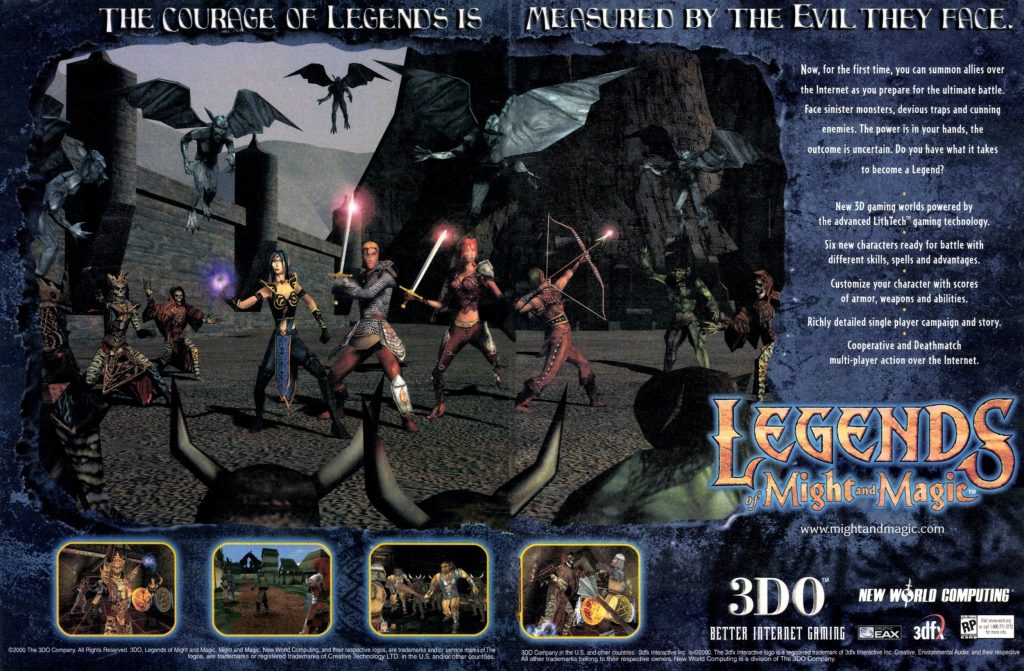
This Legends of Might and Magic advertisement represents the game’s finalized 2001 multiplayer vision, showcasing its shift from a cooperative RPG to a team-based online combat experience. Released under 3DO and New World Computing, the poster’s tagline — “The courage of Legends is measured by the evil they face.” — frames the game as an epic clash between light and darkness. It highlights six distinct playable classes, from spell-wielding Sorceresses to armored Paladins, arrayed against hordes of undead and gargoyles. The imagery captures the defining promise of LoMM: large-scale medieval warfare powered by fast-paced, first-person combat and magic.
Technically, this version was built on the LithTech 2.2 (Talon) engine, the same technology used in No One Lives Forever and Aliens vs. Predator 2, allowing for enhanced 3D rendering, dynamic lighting, and online play. The poster emphasizes these innovations—“new 3D gaming worlds,” “Cooperative and Deathmatch multiplayer action”—reflecting 3DO’s push to deliver a next-generation fantasy shooter experience. This ad marked the culmination of years of evolution, distilling Legends of Might and Magic into a fast, competitive hybrid that bridged classic Might and Magic lore with the emerging world of early 2000s online gaming.
📜 Might and Magic Franchise Montage (2000–2001)
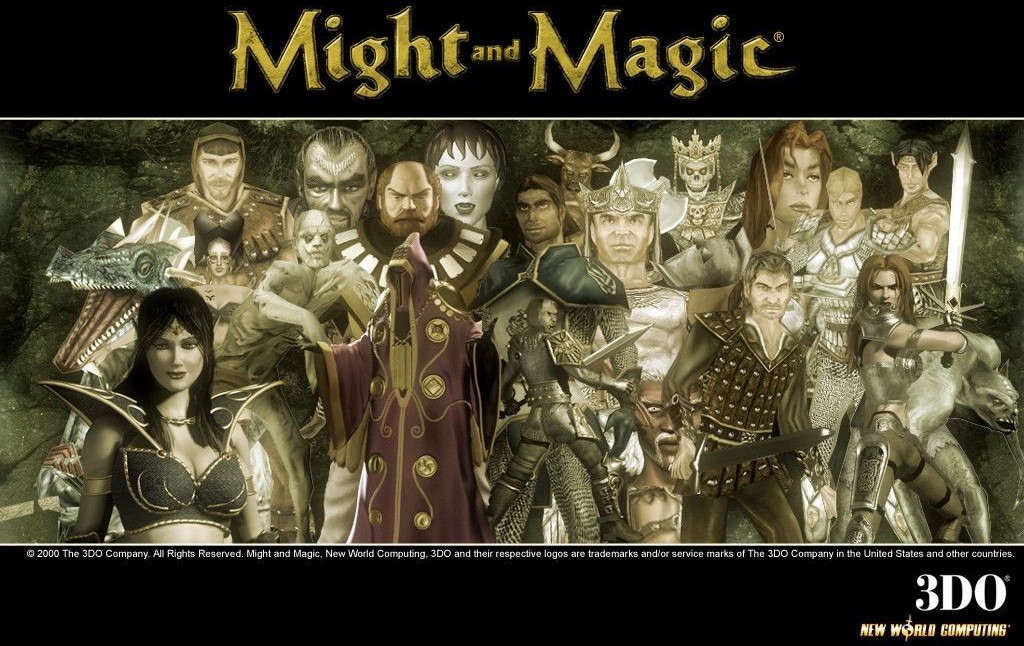
This rare promotional collage brings together an entire era of Might and Magic history in a single sweeping image. Created during the height of 3DO and New World Computing’s unified “Might and Magic Universe” push, it blends characters and creatures from both the classic RPG series and the early development cycle of Legends of Might and Magic. Hidden throughout the lineup are unmistakable LoMM class and monster renders — the Warrior, Paladin, Druid, Bandit, Archer, Sorceress, Titan, and even the Lich King — standing shoulder to shoulder with iconic heroes from Might and Magic VII and VIII.
The piece uses 3DO’s signature golden title logo and the studio’s trademark high-contrast character-collage style, a format often used in press kits, store displays, and early web banners around late 2000 to early 2001. Its inclusion of LoMM models places it right in the period when the studio was preparing to launch Legends and was actively presenting all Might and Magic properties as part of a shared world. As a result, this image acts as a snapshot of the franchise in transition — a bridge between the classic single-player RPG lineage and the emerging multiplayer vision that LoMM would soon bring to life.